Skip to content
Talkartive Studio

Devices / Mediation and accessibility

An accessible place is a place told for everyone. Based on assessments conducted by accessibility specialists, we design tailored mediation solutions: connected labels, audio content, tactile supports… to multiply the ways of discovering, understanding and experiencing heritage.

Audiences
Visual, auditory, motor, intellectual, cognitive and psychological disabilities
Supports
Connected labels, audio description, SDH subtitling, tactile maps, Easy Read, BSL
Approach
With the people concerned, from diagnosis to evaluation
For
Museums, monuments, cultural venues and living heritage

Transforming mediation through accessibility

One content, multiple pathways.

A work, an object or a place can be discovered through sight, listening, touch, movement or words. Working on accessibility means drawing on these different modes of perception to provide access to content.

Solutions more attuned to real usage.

Subtitling audio content, structuring a label, describing a work or making an interface easier to use meets specific needs. These adaptations also make visits easier in many situations.

Thinking through the entire visitor journey.

Accessibility accompanies every stage of the visit: planning the trip, finding your way, accessing content, interacting and receiving support.

Different ways to engage.

01

Labels and visitor supports

Writing, layout and production of clear, structured connected labels with multiple reading levels.

02

Studies and diagnostics

An assessment of the accessibility of your spaces, content and pathways by professionals, with concrete and prioritised recommendations.

03

Adapted solutions

Audio description, tactile maps, sign language, Easy Read and to Understand (ERU): the tools that open the venue to everyone.

04

Staff training

So that reception and mediation can accompany all visitors with care and confidence.

One label, multiple readings.

Accessible content is not impoverished content: it is the same knowledge, offered in multiple forms. Try it.

The standard version: a title, a reference point, a few lines of text. The braille and QR code provide access to the other versions.

Room 3

The North Gate

12th century, limestone

The only entrance to the fortified city, the north gate filtered merchants, soldiers and livestock. Its jambs still bear traces of the hinges that held heavy wooden doors.

Notice the wear on the threshold: centuries of passage have worn it down.
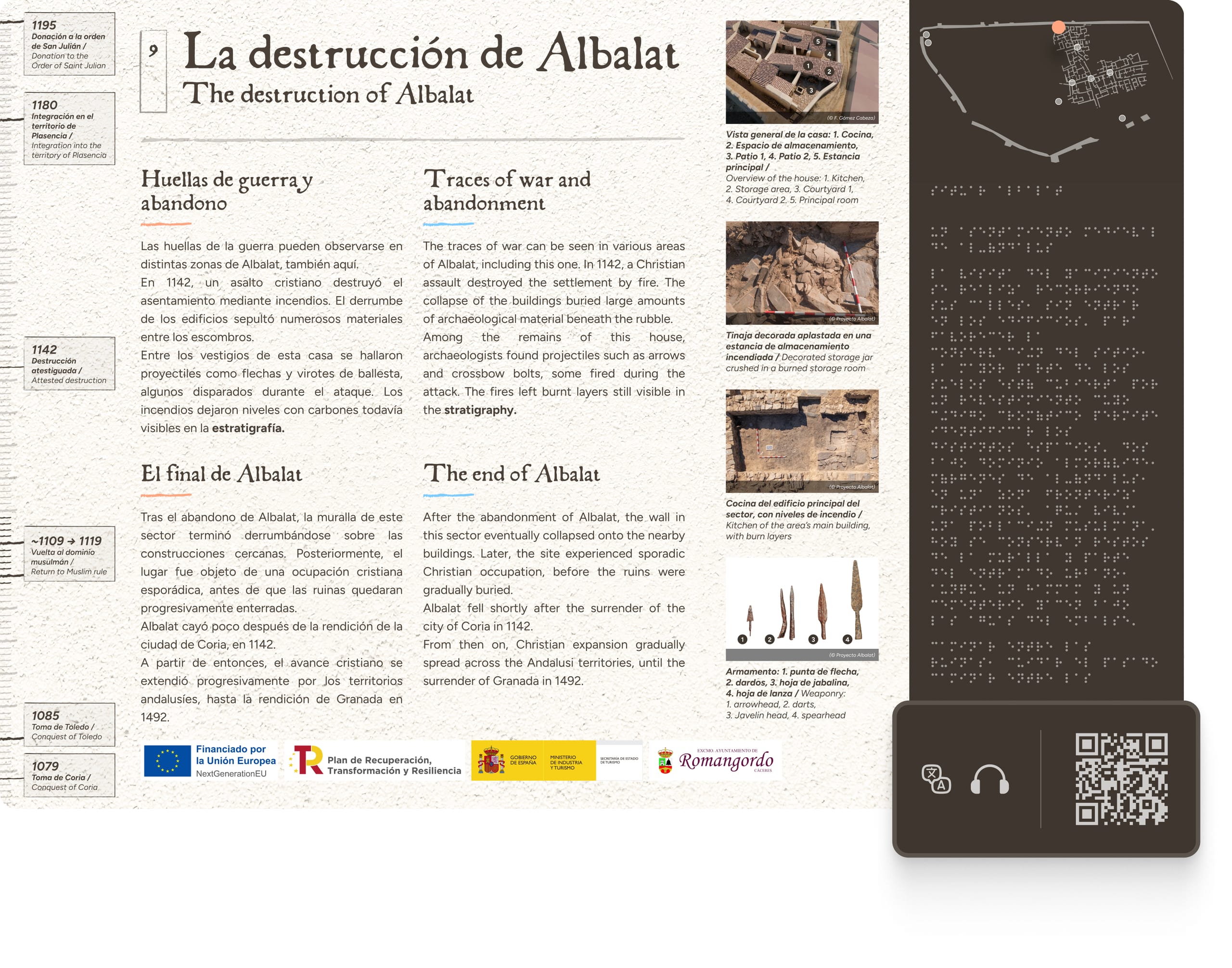
Example of a label currently on display at the Al-Balat archaeological site. Scan the QR Code to see the accessibility principles.

For every audience, precise answers.

The needs

  • Discovering the venue without relying on sight
  • Finding your way and moving around independently
  • Accessing label texts

Our responses

  • Audio description of spaces and works
  • Tactile maps and scale models
  • Braille and large-print labels, high contrast
  • Guided audio tours

Before, during, after the visit.

Accessibility is built at every stage. A single missing link can compromise the entire experience.

Prepare

Reliable, accessible practical information and materials to help visitors anticipate the flow of their visit.

Arrive

A welcoming, aware reception, clear signage, identified routes and rest points.

Visit

Content available in multiple formats: text, audio, subtitles, sign language, tactile supports or easy-to-read materials, tailored to individual needs.

Stay connected

Feedback gathered from the people involved to evaluate the tools and help them evolve.

Our approach

Accessibility is designed with audiences.It starts with their experience.

Our approach.

  1. Diagnosis

    Site visit, content and route analysis, discussion with teams and audiences.

  2. Co-design

    Solutions are designed and tested with people affected by each disability.

  3. Implementation

    Writing, recording, manufacturing and installation of adapted materials.

  4. Evaluation

    Visitor and team feedback, followed by adjustments to improve accessibility over time.

Your questions, our answers.

Yes: the diagnostic starts from what already exists and proposes concrete improvements, achievable step by step.

Yes. We work with associations, accessibility specialists and people with lived experience, depending on the project's needs.

A method that makes information easier to read and understand, designed with people with intellectual disabilities and beneficial to many other audiences.

No: the diagnostic allows you to prioritise actions and move forward step by step, according to your budget and timeline.

They can be: transcriptions, audio description and adapted versions are planned from the writing stage.

Yes: a short, practical training session tailored to your venue, to welcome every visitor with confidence.

Let's talk about your project

In 30 minutes, we explore your project, your audiences, and what sound can change for your venue. A useful conversation, no strings attached.

Would you prefer to write to us directly? hello@talkartive.com